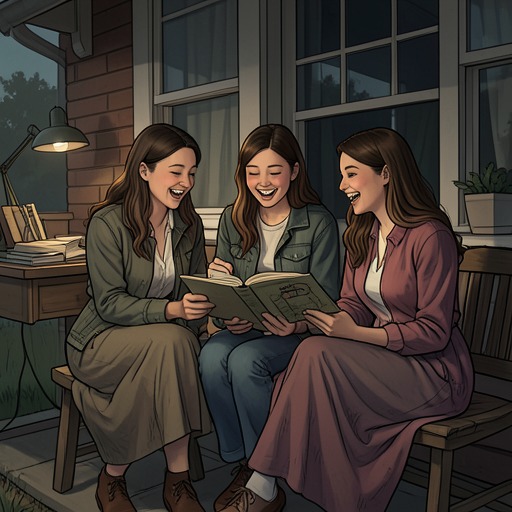
Anne Shirley and Philippa Gordon
Anne of the IslandAnne Shirley and Philippa Gordon’s friendship gives each woman a companion who can see past appearances: Philippa bluntly challenges Anne’s refusal of Gilbert Blythe, while Anne recognizes the loyalty beneath Philippa’s playful manner and shares in her happiness when she accepts Jonas Blake. Their exchanges place candor and affection side by side, making friendship a source of both painful clarity and generous affirmation.
Candor in a Moment of Rupture
After Anne refuses Gilbert Blythe, Philippa comes upon her in the moonlit gloom and guesses what has happened. Anne does not welcome her presence; at that moment she wishes Philippa were far away. But Philippa does not soften her judgment. She calls Anne an idiot, then explains that Anne may have mistaken an ideal invented by her imagination for love itself, and may be expecting actual love to resemble that ideal. The rebuke is unusually direct, but it is grounded in Philippa’s conviction that Anne is misreading her own feelings rather than simply making a choice Philippa dislikes.
Anne answers coldly, asking whether refusing to marry a man she does not love is idiotic. The exchange reveals a real difference between them: Anne insists on her present understanding of her feelings, while Philippa suspects that Anne’s romantic expectations have obscured what is in front of her. Philippa’s criticism does not resolve the disagreement. Anne asks to be left alone because her world has fallen to pieces and she needs to reconstruct it. Her response makes clear that the refusal has consequences beyond the decision itself: the prospect of losing Gilbert’s companionship has unsettled her sense of her world.
As Philippa leaves, she asks whether Anne intends to rebuild that world without Gilbert. The question stays with Anne. She imagines such a world as lonely and forlorn, yet tells herself that Gilbert has spoiled their beautiful comradeship and that she must learn to live without it. The scene gives Philippa’s challenge force without making Anne instantly accept it. Anne is left to sit with the painful implication herself, and her insistence that Gilbert is at fault coexists with her recognition of how empty his absence might feel.
Seeing Beneath the Surface
Later, amid the stillness of a pine wood, Philippa abruptly tells Anne that she is the happiest girl in the world. Anne already understands the reason: Jonas Blake has asked her to marry him. Philippa recounts that she sneezed three times during the proposal and said yes before he had finished, afraid that he might change his mind. Her account mixes a comic mishap with an unmistakable urgency. She had not believed Jonas could care for someone she thought of as frivolous, and she is surprised to discover that she loves him.
Anne answers not with a teasing judgment but with a serious defense of Philippa’s character. She tells her that beneath her frivolous exterior is a loyal, womanly soul and wonders why Philippa hides it. Philippa agrees that she is not frivolous at heart, while describing that manner as a kind of outer skin she cannot simply remove. She is not claiming to have changed into someone solemn; she is saying that Jonas knows and loves the person beneath the performance, frivolity included. Anne’s response matters because it recognizes a self Philippa herself says is difficult to show, without requiring her to disclaim the lively persona her friend knows.
Philippa’s surprise at loving Jonas also complicates the romantic assumptions that have shaped their earlier conversation. She had not imagined falling in love with a man she considered ugly, and she jokes about having only one suitor and giving him the short name Jo. Her happiness is not presented as the fulfillment of a carefully composed ideal; it arrives as a discovery that overturns what she thought she could want. In the pine-wood conversation, the friend who questioned Anne’s ideas about love speaks from her own experience of being surprised by it.
Friendship and Contrasting Romantic Expectations
Anne responds to Philippa’s engagement with teasing recollection of Philippa’s former insistence that she would never marry a man who was not rich. Philippa does not deny the change; she says she will be poor as cheerfully as she was rich and intends to learn cooking and dressmaking. She has learned to market while living at Patty’s Place, and mentions having taught a Sunday school class for a summer. She also reports Aunt Jamesina’s concern that marriage might ruin Jonas’s career, but rejects the idea that she has no contribution to make: she believes her ability to make people like her will help her become a source of support. Her description of herself as Jonas’s little candlestick turns affection into a practical promise of encouragement, however playfully expressed.
Anne calls Philippa incorrigible, but says that she loves her too much to make a neat, congratulatory speech and is genuinely glad of her happiness. Philippa understands the feeling in Anne’s eyes as real friendship, even as she imagines that Anne will one day look at her in the same way. Their closeness is not founded on identical temperaments or identical judgments. Philippa can be irreverent and theatrically self-deprecating; Anne answers with grave, attentive recognition. In this moment, teasing and seriousness work together: Philippa can celebrate without pretending to become solemn, and Anne can express love without disguising her concern for her friend’s character.
The Unsettled Question of Anne’s Future
Philippa turns from her own engagement to ask whether Anne will marry Roy Gardner, noting that people at Redmond believe he is very much in love with her and asking whether Anne loves him. Anne refuses to accept a proposal in advance, invoking the comic example of a woman who refused a man before he had asked. Her answer leaves her future open rather than confirming Philippa’s prediction. The exchange recalls the earlier conflict over Gilbert without making Anne’s feelings for Roy equivalent to her feelings about Gilbert: the evidence offers Philippa’s question and Anne’s refusal to decide before being asked, not a final answer.
Together, the two conversations show the friendship as a relationship in which frankness does not cancel tenderness. Philippa risks hurting Anne by naming what she believes Anne cannot see; Anne, in turn, gives Philippa an affirming account of the loyal self beneath her frivolous exterior. Their differing approaches to love sharpen the contrast: Philippa finds herself unexpectedly devoted to Jonas, while Anne remains guarded about what a future proposal from Roy might mean. The friendship does not settle Anne’s romantic uncertainty, but it gives her a trusted voice willing both to challenge her and to share her joy.